


Today I wanted to let you know about a new and very important change in New York State Law amending the law currently known as "Leandra's Law" or the Child Passenger Protection Act.
As you should be aware, Leandra's Law imposed strict penalties on the operation of a vehicle with children in the car while intoxicated. It mandated that an ignition interlock device, or IID, be installed in the vehicle of anyone convicted of driving while intoxicated. Furthermore, if a person is convicted under the law, they will be reported to The Statewide Central Registry of Child Abuse and Mistreatment.
Recently, Governor Cuomo signed legislation to make Leandra's Law even tougher. The new law makes it a class "E" felony to drive intoxicated on a conditional license rather than just a traffic infraction, which is not a crime. Driving while intoxicated with a revoked license will remain a felony.
The law also limits the circumstances when Court can waive the installation of the IID. Now the installation can only be waived when the person swears under oath they are not the owner of any motor vehicle and will not drive during the period of the interlock restriction. If the person lies under oath, it is considered perjury, which is a felony.
Obviously, every driver should drive safely and responsibly, but contact an experienced DUI attorney in the event that you are charged with a DWI or any traffic offense.
Kevin P. McKernan is a member of the National College of DWI Attorneys.

Showing posts with label children. Show all posts
Showing posts with label children. Show all posts
Thursday, December 26, 2013

Wednesday, November 13, 2013
Aggravated Assault Becomes Class "E" Felony
A law concerning aggravated assault was recently amended by Governor Cuomo. Penal Law 120.12 originally made it a Class E felony for a defendant who was 18 years or older to have committed assault in the third degree against a child if the defendant had been previously convicted of such a crime within the past three years. Governor Cuomo has signed an amendment into law that mandates that the look back period be extended to ten years instead of just three. This means more offenders who commit assault on a child can be prosecuted.
In New York, there are five types, or classes, of felonies. A Class E Felony is the lowest category, associated with the shortest jail sentences. However, being convicted of a felony is considered much more serious than being convicted of a misdemeanor or violation. Felonies are associated with longer jail time and limitation of your employment prospects. Felony sentences can be particularly harsh if you are a multiple time offender like those who will be affected by Governor Cuomo's amendment.
If you are charged with a felony, you should absolutely contact an attorney. An attorney can advise you of your options and work with the court for a lesser sentencing. If you are in need of an attorney, please contact my office at 718-317-5007.
- Kevin P. McKernan
In New York, there are five types, or classes, of felonies. A Class E Felony is the lowest category, associated with the shortest jail sentences. However, being convicted of a felony is considered much more serious than being convicted of a misdemeanor or violation. Felonies are associated with longer jail time and limitation of your employment prospects. Felony sentences can be particularly harsh if you are a multiple time offender like those who will be affected by Governor Cuomo's amendment.
If you are charged with a felony, you should absolutely contact an attorney. An attorney can advise you of your options and work with the court for a lesser sentencing. If you are in need of an attorney, please contact my office at 718-317-5007.
- Kevin P. McKernan
Friday, July 26, 2013
The Importance of a Will: Protect your Life Savings!

Throughout my years as a lawyer, I've noticed one commonality. Here’s the scenario: A beloved parent dies after a long illness. After a few days, the smoke clears and the children are suddenly left to deal with Mom or Dad’s Estate. Unfortunately, Mom and Dad never thought about making a will because they always thought that their possessions would just pass to their children automatically, but everyone is now realizing that that isn't necessarily true.
Cue the calls to my office.
I don’t mean to make light of such a difficult situation, but simply point out the importance of having a Will drawn up. The fact is, without a Will, when you pass away you are legally known as “intestate”. This means the fate of your estate depends entirely on the Court’s decision. What will occur is that the Court will hold a hearing to decide who the rightful heirs to your estate are and then decide accordingly. Unfortunately, this sometimes results in your estate not being split the way you intended.
How can you avoid this?
NY Divorces: Protect Yourself! Learn about adultery, abandonment, and other grounds for contested and uncontested divorce
Divorce is hard on everyone in a family. If you are considering divorce, you probably have a million things running through your mind: How will the kids feel? What will happen to the house? How do I even begin this process?
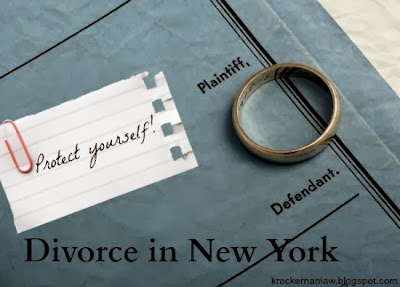
Divorces fall into two major categories: contested and uncontested. An uncontested divorce usually occurs when you and your spouse agree on all the issues that come along with divorce, including the distribution of your finances, child support and visitation, and spousal maintenance. If you and your significant other cannot come to an agreement on these issues before your court date, you will have to file for a contested divorce. A contested divorce can raise the cost of your divorce exponentially, however, many people believe it is worth it when they feel strongly about certain issues such as their children’s care or remaining in their marital residence.
If you wish to petition for a contested divorce, you must choose one of the six grounds for divorce in New York State.
Click below to learn the grounds for divorce in New York.

Divorces fall into two major categories: contested and uncontested. An uncontested divorce usually occurs when you and your spouse agree on all the issues that come along with divorce, including the distribution of your finances, child support and visitation, and spousal maintenance. If you and your significant other cannot come to an agreement on these issues before your court date, you will have to file for a contested divorce. A contested divorce can raise the cost of your divorce exponentially, however, many people believe it is worth it when they feel strongly about certain issues such as their children’s care or remaining in their marital residence.
If you wish to petition for a contested divorce, you must choose one of the six grounds for divorce in New York State.
Click below to learn the grounds for divorce in New York.
Subscribe to:
Posts (Atom)